
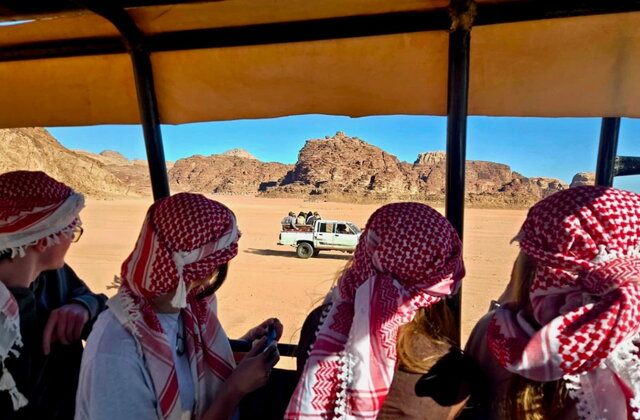
Nicolas Jaimes was in the middle of taking the LSAT in Amman, Jordan, when he heard the missile strikes.
A junior at Cornell, the 20-year-old New York City native had spent less than two months in Jordan for his study abroad program, learning Arabic and studying regional politics, when the United States launched Operation Epic Fury on Feb. 28.
Within days, his program was sending students home.
On March 2, the Department of State advised all Americans to leave. CET Jordan, Jaimes’ study abroad program, informed him and other students they had to return home. Jaimes paid $2,500 for a flight home three days later. His program would continue online through the end of April.
Jaimes’ experience is part of a larger trend of a decline in the number of students willing and able to study abroad in the Middle East. In the 2023-2024 school year, the first year of the war in Gaza, 4,872 American students studied abroad in the Middle East and North Africa, down nearly 30% from the year before, according to the Institute of International Education.
Experts expect those numbers to continue to decline with the war in Iran, which has killed thousands and upended global trade routes. Experts worry that as U.S. military action grows in the Middle East, fewer students will learn about the complexities of the region and American foreign policy from abroad.
“Every time we have a moment like this, it just feels like opportunity and challenge,” says Elena Corbett, the senior director for academic engagements at Amideast, an U.S-based nonprofit focused on education and training in the region. “Educational opportunity, ways to learn from others, that world just shrinks a little bit.”
“You can see that this can impact us in a negative way, having less students, having less applicants,” she says. “People stop spending money here in Lebanon, and this is one impact, which is the economic side.”
Travel Advisories Take a Toll
U.S. embassies across the Middle East issued emergency statements in the wake of Iran’s retaliatory strikes, which directly hit the U.S. embassies in Riyadh, Saudi Arabia, and Kuwait City, Kuwait.
Jaimes worries that U.S. foreign policy, such as the embassy warnings and security designations, will deter people from wanting to study abroad in the Middle East.
“I think the biggest impact is just students being afraid to go,” Jaimes says. “I mean, even before I went, people were telling me, ‘Oh, it’s not safe…’ And so now I expect people are going to be even more hesitant.”
Universities often restrict travel to countries under high-level State Department advisories, and insurers conduct independent security assessments before approving study abroad programs. But Crisis24, which provides security assessments for Blue Cross Blue Shield Global Solutions, says the advisories are only one factor in deciding which programs receive insurance coverage, and therefore which programs can continue.
And sometimes universities discourage or outright forbid travel to places deemed unsafe as a result of State Department announcements, Corbett says.
“There are a lot more rules in place, and there’s a much stricter kind of risk management framework under which you’re operating” when traveling through a university-sponsored program, Corbett says. “We can’t have a program for Americans on the ground when there are no consular services available.”

The sky over Amman, Jordan, on Feb. 28, the day Operation Epic Fury began.
Impact on Students’ Learning
As fear rises about Americans traveling to the region and restrictions rise, Mary D’Ambrosio, a journalism professor at Rutgers University who takes students on yearly reporting trips, says she is concerned that anxiety will dictate what parts of the world students can seek to understand.
“If things are like they are now, I think the feeling would probably be ‘Gee, let’s go to Spain,’” she says. “So then, of course, it’s hard to cover the stories if we’re shying away from anything that’s even somewhat dicey.”
But some students aren’t deterred. Jaimes says he hopes the CET Jordan program will resume in person for future cohorts of students who wish to travel and study in Jordan and the wider Middle East – and he hopes to return to the Middle East one day.
“I think the biggest thing is just the connection with the people like I had,” Jaimes says. “I just miss out on those daily interactions that I might have had with Jordanians, with shopkeepers.”
Published in conjunction with
