
WASHINGTON – Rallying outside of the Wilson Building, local advocates, immigrants and councilmembers demanded the mayor and local legislators put a stop to U.S. Immigration and Custom Enforcement’s “Secure Communities” program.
Also known as S-Comm, the program was enacted to “prioritize the removal of criminal aliens, those who pose a threat to public safety, and repeat immigration violators,” according to ICE.
S-Comm allows the Federal Bureau of Investigation to automatically send fingerprints to ICE to check its immigration databases when a person is booked into jail. This can be prior to the individual being convicted. Some are then deported depending on state and local law enforcement’s jurisdiction.
Protestors entered the building where the District of Columbia Mayor and local councilmembers offices are located, to lobby and demand they take immediate action after the rally.
“We’re here to tell them to defend our civil rights, defend public safety, defend families. We need you to pass an executive order Mayor. And we need the council to turn that into law,” said Sarahi Uribe of the National Day Laborer Organizing Network.
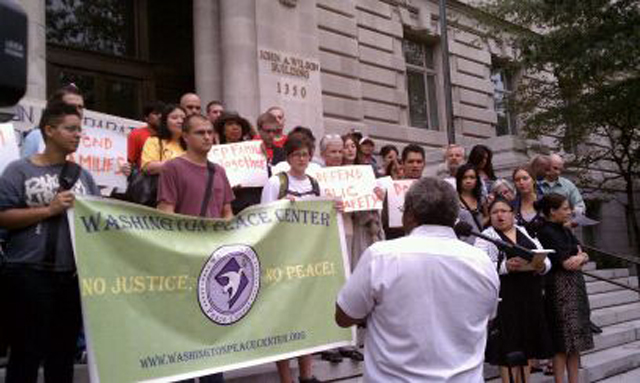
Johnny Barnes, director of the ACLU D.C. chapter, spoke to ralliers about his hope that S-Comm be stopped.
Matias Ramos, founder of United We Dream, an organization that helps promote legal status for immigrant youth, was arrested in Minneapolis while attending an immigrant youth conference in February 2010. He emigrated from Argentina when he was 13 years old. Ramos said he reported to ICE when required but had to wear an ankle-monitoring bracelet and could not leave the D.C. area because of the S-Comm program.
“One thing that Secure Communities will do, is it will systematically erode the trust between police enforcement and the communities they’re supposed to serve and protect,” he said.
Rob Hampton, executive director of Black Law Enforcement in America, said S-Comm prevents many immigrants from reporting crime because they are afraid of being deported.
“We need to have relationships with our community not be worried about whether or not people fear the police.”