
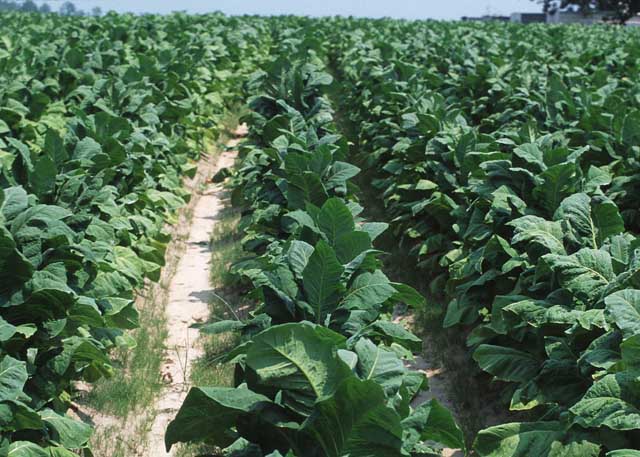
More than 8,000 foreign workers have been certified to work in North Carolina within the past year. Above, a tobacco crop in North Carolina (Bob Nichols/USDA)
WASHINGTON — While more than one in 10 North Carolinians are without work, thousands of farm jobs paying more than minimum wage are being filled by immigrants, most coming from Mexico, through a legal, temporary work program.
This year alone North Carolina farmers were granted permission to hire 8,547 temporary foreign agricultural workers, by far the most of any state. This represents more than 10 percent of the state’s agricultural workforce, according to the Employment Security Commission of North Carolina.
The jobs pay $9.30 to $9.59 an hour and must first advertised to Americans before foreign workers with H-2A visas – the name of the temporary agriculture work permits – can fill the positions. This has sparked a debate as to why these jobs are being filled by temporary immigrant workers and not U.S. citizens during a period of severe unemployment.
H-2A Worker rights: Workers are entitled to…
Pay
- written information about wages, hours, working conditions and benefits in a language understood by the worker, prior to their arrival;
- be paid in full, at the agreed rate at least twice a month;
- receive a statement of earnings for each pay period.
Housing/meals
- free and safe housing;
- three meals at a fixed cost or access to convenient cooking facilities.
Additional benefits
- free transportation or compensation for travel to and from the worksite from the country of origin after 50 percent of the work contract is complete;
- state worker’s compensation insurance by their employer;
- at least 75 percent of the total hours promised in the work contract;
- obtaining H-2A certification (application and recruitment fees) at no cost to them.
As a condition of H-2A certification, employers…
- cannot dismiss U.S. workers within 60 days of the date of need for H-2A workers;
- applying for H-2A workers must hire any eligible U.S. worker who applies during the first half of the employment period;
- must demonstrate a lack of domestic workers by extensively advertising H-2A positions prior to hiring foreign workers.
Farmers and industry advocates say Americans simply do not want these jobs due to the laborious and seasonal nature of the work.
“I don’t care if you pay them $20 an hour, you are not going to get them out here to do this type of work,” said Wilson Daughtry, a vegetable farmer in Engelhard, N.C., speaking of U.S. workers. “You might get them out here for a day or two. But they are not going to be out here day after day, month after month to perform the work.”
But farm worker advocate groups say some employers seek to import labor because the structure of the H-2A program and the immigrants’ opportunity to earn more than in their native countries make the foreign workers amenable to tougher work conditions and allow farmers to avoid paying more for domestic workers in the open market.
“I don’t buy the argument that I’ve heard many growers make that Americans are just not prepared to do this kind of work,” said Mary Bauer, legal director of the Southern Poverty Law Center and author of Close to Slavery, a report alleging abuses of the H-2A program. “For centuries, Americans have performed agricultural labor.
“Many workers do not want these jobs at these wages and on these terms,” Bauer added. But “if you can’t find workers at the wage you want to pay, then lo and behold there’s this program you can use that allows you to go find people from another country who will desperately want to make a job at $7 or $8 an hour.”
In June, Legal Aid of North Carolina filed a lawsuit on behalf of 11 U.S. farm workers alleging Daughtry and his wife discriminated against the Americans to push them out so the positions could be filled with H-2A workers.
However, Daughtry, 49, said the workers were held to the same standards as his other employees. The workers didn’t have an accurate understanding of how hard the work was before beginning and so they quit, according to Daughtry.
“They were treated the same way as everybody else in the field and for whatever reason they couldn’t do the work or chose not to do the work,” he said. “Growing up as a young person, I was expected to do the same type of work. There is nothing unusual of what these people are doing.”
Unemployment statistics from the state do not point to Americans flocking to these jobs.
From July 2010 through June, the Employment Security Commission of North Carolina advertised 9,050 openings that would go to H-2A workers if not filled by Americans first. Only 752 U.S. worker referrals were made. The commission does not track whether the workers were hired.
“This is a misconception to say that farmers prefer foreign workers,” said Lee Wicker, a tobacco farmer and deputy director of North Carolina Growers Association. “We don’t. We just want workers that are going to come and stay and help us” plant, grow and harvest our crops.
With the need to fill thousands of vacant positions, farmers say they are faced with a dilemma: Either use the legal channel of the H-2A program or resort to illegal workers.
“We stepped up to try and do the right thing,” Daughtry said of entering the H-2A program four years ago. He noted that the H-2A program requires him to provide transportation, housing and the cost of visas for the legal migrants, which drive up his costs while competitors who hire illegal workers don’t incur the same costs.
The North Carolina Growers Association is largely responsible for the proliferation of the H-2A visas in North Carolina. From July 2010 to June, NCGA was certified to use about 7,000 foreign workers.
Typically, foreign workers contract directly with one farmer for the growing season, and can only work for that employer. But the NCGA member farms pool resources, splitting the fixed costs of employing H-2A workers while sharing the labor force because different crops require assistance at different times throughout the year.
“We can move workers from farm to farm that maximizes the efficiency for the growers to participate,” Wicker said. “The other big thing that it does, it allows NCGA and our farmers to maximize the employment opportunity for these workers.”
The NCGA exceeded the federal program requirements in 2007 when it signed a collective bargaining agreement with the AFL-CIO’s Farm Labor Organizing Committee to cover the legal migrants, according to NCGA’s website.
Beyond the guarantees of H-2A program, the agreement provides injury pay and a formal grievance resolution process.
“These guys are not chained and shackled at night,” Wicker said. “They can come and go as they please. The only thing that keeps them here is that they want these jobs.”