
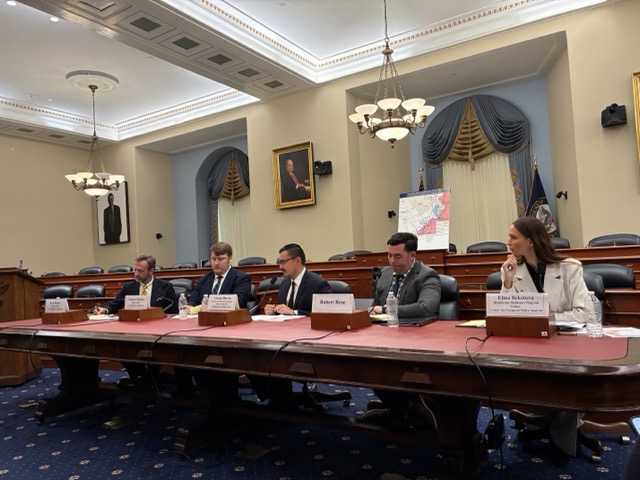
WASHINGTON — Experts stressed Ukraine’s need to maintain control over its so-called fortress belt, a roughly 31-mile stretch of defensive infrastructure in the country’s east, during a public briefing on Capitol Hill Wednesday.
“The fortress belt is essential to ensuring that Ukraine maintains a geographically defensible front line in eastern Ukraine,” said panelist George Barros, director of innovation and open source tradecraft at the Institute for the Study of War, a Washington-based conflict monitor. “One of the prerequisites for a robust and sustainable peace is ensuring that at the end of the day, Ukraine maintains a geographically defensible front line.”
The briefing, held by the Commission on Security and Cooperation in Europe, a bipartisan U.S. government body, came as U.S.-led talks to end the fighting in Ukraine have been on hold as the Trump administration’s focus has been diverted to the war in Iran. But according to Ukrainian President Volodymyr Zelenskyy, as recently as late last month, a U.S. proposal to end the war involved Ukraine ceding the remainder of its eastern Donbas region to Russia in exchange for U.S. security guarantees. This would include territory that Russian forces have proved unable to take by force, including the fortress belt. Zelenskyy has so far resisted any ceasefire agreement that involved ceding Ukrainian territory to Russia.
The Kremlin has made controlling all of Donbas a central aim of its war effort, but what Russian forces failed to gain on the battlefield in more than four years of full-scale war, Russian President Vladimir Putin now seeks to capture through a negotiated settlement.
Experts on Wednesday’s panel stressed that Russia would not be able to take the area by force for years, if ever. Doing so would cost Russia enormously in terms of men and materiel.
“While Russia remains dangerous, a collapse of Ukraine’s defenses is unlikely,” Barros said. “Under optimized assumptions that benefit Moscow, Russian forces may be able to seize Donetsk in late 2027 or early 2028 assuming Ukraine’s international partners continue to support Ukraine.”
Over 11 years, Ukraine has constructed an elaborate network of fortifications that includes miles of fighting positions, anti-vehicle obstacles and minefields in the northern Donetsk Oblast spread over an area roughly the distance from Washington to Baltimore. While much of eastern Ukraine is flat, the fortress belt sits atop elevated ground, making it prime terrain for a defending force to hold. Conversely, the region to the west of the fortress belt that would become Ukraine’s new frontline if Donbas were ceded to Russia, is flat, sparsely populated and home to fewer towns and roads to support logistics.
“This fortress belt reminds me of the whole situation with Crimea,” said panel member Elina Beketova, a fellow at the Center for European Policy Analysis and a former journalist from Crimea. “For many, many years, Ukrainians were told that diplomacy will work, that it will fix everything. But then eight years after (Russia’s 2014 annexation), the Crimean Peninsula has been used by Russian forces to advance and shoot missiles into the mainland of Ukraine.”
Even if Zelenskyy wanted to trade the Donbas for a ceasefire, he does not have the authority to do so. Under the Ukrainian constitution, changes to the country’s borders must be approved through a national referendum. Any effort to that end would likely spark sharp domestic pushback, experts say.
Trump said during the 2024 campaign that he would end the war his first day back in office, but a settlement has so far evaded him more than a year into his second term. Several rounds of trilateral negotiations have failed to produce an agreement. The war in Ukraine has been enormously destructive to the country, resulting in over half a million Ukrainian battlefield casualties according to an estimate by the Center for Strategic and International Studies.
Robert Rose, a panelist and chief research officer at Westpoint’s Modern War Institute warned against expedient settlements at the cost of lasting peace. Rose, speaking in his personal capacity, illustrated his point by citing Nazi Germany’s 1938 annexation of Czechoslovakia’s Sudetenland, the country’s German-speaking border region, home to an expansive fortification system. In an attempt to avoid war, the British and the French allowed Nazi Germany to annex the Sudetenland. With its main defensive line gone, Czechoslovakia easily fell prey to Hitler’s push into the rest of the country the following year.
“Just as in the Sudetenland, relinquishing the fortress belt to Putin will help him subjugate the rest of Ukraine,” Rose said.