
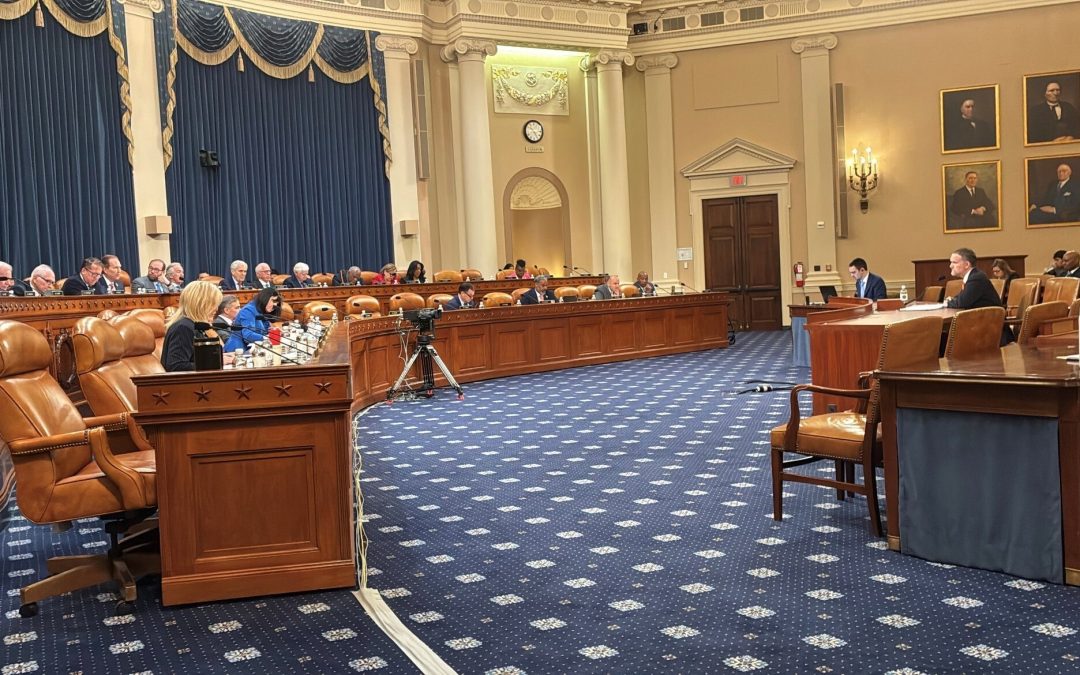
WASHINGTON — U.S. Trade Representative Jamieson Greer repeatedly stated on Wednesday that he thought prices have not increased since last year and consumers are not paying more because of tariffs. Data from the Federal Reserve, U.S. Bureau of Labor Statistics and some studies suggest otherwise.
During the House Ways and Means committee hearing, Greer was questioned by several representatives about the Trump administration’s tariff policies and rising prices.
“Ambassador Greer, are prices on consumer goods lower today than they were a year ago?” Representative Linda Sánchez, D-Calif., asked.
Greer responded with, “Well, for some of them, they are for sure. Some are still coming down from the 9% inflation rate from—”
Sánchez interrupted him by repeating her question. Greer clarified his position that he thought consumer goods prices were lower, with the exception of energy prices.
“Prices are lower, really?” Sánchez asked. “You can try to spin it any way you want, but I think consumers unanimously agree that President Trump has failed on his promise to bring down costs.”
According to the U.S. Bureau of Labor Statistics, consumer prices increased by 3.3% from March 2025 to March 2026.
Greer explicitly stated that he thought every day Americans did not pay higher prices because of tariffs when questioned by Sánchez about whether he thought the average American should be compensated because of tariffs.
“They haven’t been paying higher prices because of these tariffs,” he said. “Wages have outpaced inflation all year long.”
According to the Federal Reserve, retail prices gradually increased in 2025 because of tariffs. The FEDS Notes—which are articles that Federal Reserve board officers write—published in March 2026, state that consumers have paid at least 30% more on goods imported from China because of tariffs from April 2025 to December 2025.
Representative Jodey Arrington, R-Texas, defended the Trump administration’s trade policies by stating he thought inflation was caused by the previous Biden administration.
“What needs to expire is this false narrative that somehow inflation was a problem that occurred on account of the policy decisions of this president and Republican leadership,” Arrington said. “Unless we have a bad case of amnesia, let’s recall the four years of failed economic policies, zero leadership in trade, unbridled spending that drove this country to a place where we had inflation like we haven’t experienced in almost a half a century.”
According to the U.S. Inflation calculator using data from the U.S. Bureau of Labor Statistics, the inflation rate was 7% in 2022, 6.5% in 2023, and 2.7% in 2025.
An MIT Sloan study found that the primary reason for a sharp increase in inflation during 2022 was because of federal spending.
Arrington added that his district, which he described as highly involved with agriculture, struggled more with food prices during the Biden administration than the current Trump administration.
“It’s amazing, we never heard this narrative from our Democrat colleagues, Mr. Ambassador, until now, but I think it’s important to set the record straight,” Arrington said. “I’m reminded, by the way, that food prices, because we have a lot of agriculture, a lot of fruit producers in my district, went up by almost 30% during the tenure of President Biden and only 2% since this president has been in office.”
Representative Terri Sewell, D-Ala., said that in a survey by the American Farm Bureau, 92% of Alabama farmers said that their economic situation worsened under the current Trump administration.
Fertilizer prices is a concern for her district, she added, stating that “30% of the world’s fertilizer supply passes through the Strait.” Access to the Strait has been highly contested due to the U.S.-Iran war that President Trump initiated.
She asked Greer what he would say to Alabama farmers who are faced with higher prices.
He said that a lot of farmers bought fertilizer in advance. However, Greer acknowledged that farmers “buying on the spot market” pay a higher cost for fertilizer. Spot markets are for commodities bought or foreign exchange for immediate purchase.
Sewell added that there was a “disruption” with the Strait, to which Greer agreed and defended the U.S.-Iran war despite its impact on costs.
“There has been disruption, yes, I mean, nothing is cost-free,” Greer said.