
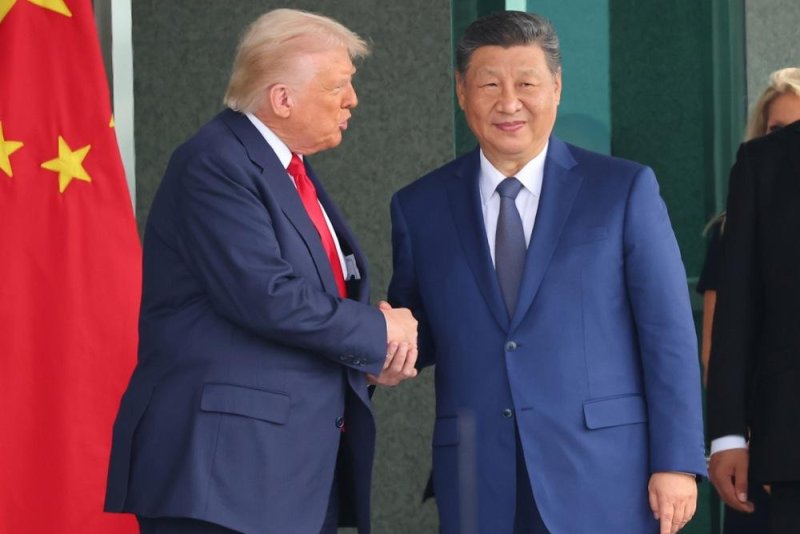
U.S. President Donald Trump, shown shaking hands with Chinese President Xi Jinping in South Korea in 2025, will fly next week to meet Xi in Beijing. File Photo by Yonhap/EPA
WASHINGTON – As President Donald Trump prepared for his meeting with China’s president Xi Jinping in Beijing next week, Japanese lawmakers urged the U.S. to remain focused on the U.S.-Japan alliance in artificial intelligence and critical minerals.
Trump said at a White House meeting on Monday that the U.S. was outrunning China in the AI race.
“I’m going to go see President Xi in two weeks. I look forward to that, but I’ll say ‘I’m leading,’” Trump said in a joking manner. “We have very friendly competition, but it will actually be a very important trip.”
The Japanese politicians underscored the importance of the U.S. maintaining a strong partnership with Japan in order to further Trump’s AI ambitions and reduce dependence on China for supply chains.
“No one country can build the entire AI stack alone. Not Japan, not even the United States. We are interdependent in filling certain layers of the AI stack to make this work and function, and we need collaboration in that front,” Akihisa Shiozaki, Deputy Secretary General of the Liberal Democratic Party, said at a Brookings Institution panel Monday.
For instance, he said Japan is very strong in semiconductor manufacturing and materials, and the United States has innovative AI development companies.
“There’s a lot of room for additional collaboration and alliance between these nations,” Shiozaki added. “The United States should not be distracted from what is most important.”
A market report released by the Semiconductor Industry Association last year showed that China had been expanding its government expenditures on semiconductor research and development, and outpacing Japan and Europe in semiconductor sales by 20%. Still, Japan’s semiconductor supply accounts for 8.2% of the global market, nearly twice China’s share.
Shiozaki was part of a delegation of three Japanese lawmakers from the Liberal Democratic Party, Japan’s ruling party. They stressed that the U.S. and Japan need to collaborate in the face of China’s export restrictions on rare earth minerals and refining technologies and dominance in various types of manufacturing.
“To put it frankly, we are dealing with China, which produces a third of manufacturing goods,” said Keiro Kitagami, a member of Japan’s House of Representatives and former Ministry of Finance official. “One country alone cannot insulate itself or try to deter China’s weaponization of economic means, so we have to get together.”
Data from the International Energy Agency show that China is the leading refiner, holding 70% of the global average market share for 19 of 20 important strategic minerals. The Chinese government announced export controls last month on seven heavy rare earth elements, affecting the global energy supply chain for countries like Japan, which rely on a small number of suppliers.
Mira Rapp-Hopper, a former Biden administration advisor on East Asia and Oceania, said the relationship between the U.S. and Japan was more important than ever because of the current geopolitical climate. She mentioned how the combination of the Strait of Hormuz closure and China’s export restrictions exposed Japan’s vulnerabilities in energy and mineral imports.
Rapp-Hopper said that if the U.S. wanted to reduce supply chain dependence on China, it needed to prepare for long-term policy coordination with Japan. She pointed to Japan’s importance in protecting against various issues posed by China, including potential military defense and tech privacy risks.
“We’re long-standing allies where our strategic interests have never been more aligned,” said Rapp-Hopper. “Whether you’re worried about potential military defense risks from China, you’re worried about our semiconductor industry and ability to protect our sensitive tech, whether you want critical minerals independence, whether you want to make sure that AI is something on which we still have the leading edge, and we’re also governing it safely, Japan is critical to every single one of these decisions.
Before Japan’s prime minister Sanae Takaichi’s first bilateral meeting with Trump at the White House in March, the White House announced a memorandum of cooperation regarding the technology prosperity deal with Japan. The deal was designed to accelerate AI adoption and innovation and build a reliable AI ecosystem in the Indo-Pacific. It also emphasized leading-edge semiconductor technology collaborations between the U.S. and Japan to enhance the foundational infrastructure of AI performance.
Then, after a White House news conference last month, Trump accused Japan and other allies in the Pacific of not offering more support in the war against Iran. He said Japan “didn’t help us,” even though the U.S. has 55,000 troops in Japan, according to data from the U.S. Government Accountability Office.
The U.S. has maintained long-term military defense cooperation with Asia-Pacific countries to protect U.S. allies against China and North Korea.
Now with Trump on his way to China to address important issues such as critical minerals, Rapp-Hopper said the president must also keep Japan in mind during that trip and moving forward.
“I would say to this administration and others that it’s really important to make medium and long-term choices in all of our relationships and understand that in any type of system we seek to build and protect in the 21st Century, Japan is a critical part, and there’s no way around that,” said Rapp-Hopper.
Published in conjunction with United Press International.