WASHINGTON — American journalist Reza Valizadeh visited his elderly Iranian parents in March 2024 for the first time in 15 years. Valizadeh’s stories for Voice of America and other U.S. government-funded outlets often criticized the Iranian regime. So before traveling, he sought and received confirmation that he would be safe from a high-ranking commander in the Islamic Revolutionary Guard Corps, a branch of Iran’s armed forces. However, in September that same year, the Islamic Revolutionary Guard Corps arrested Valizadeh, and Tehran’s Revolutionary Court sentenced him to ten years in prison for “collaboration with a hostile government.”
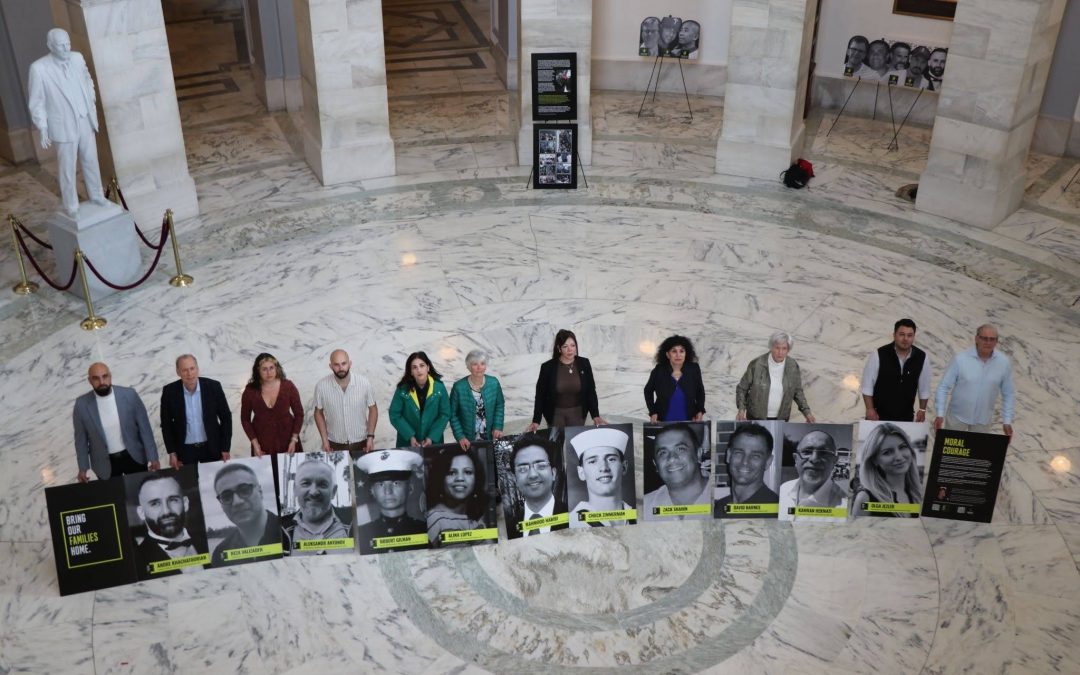
In the Rotunda of the Senate Russell Building last week, the Bring Our Families Home campaign set up portraits of Valizadeh and 12 other Americans currently wrongfully detained overseas. The group, family members of illegitimately detained Americans, appealed to Congress to push for their safe return. Each foam poster board included the name, home state, and country of detainment. The display also included portraits of the 33 people released after advocacy by the James W. Foley Foundation.
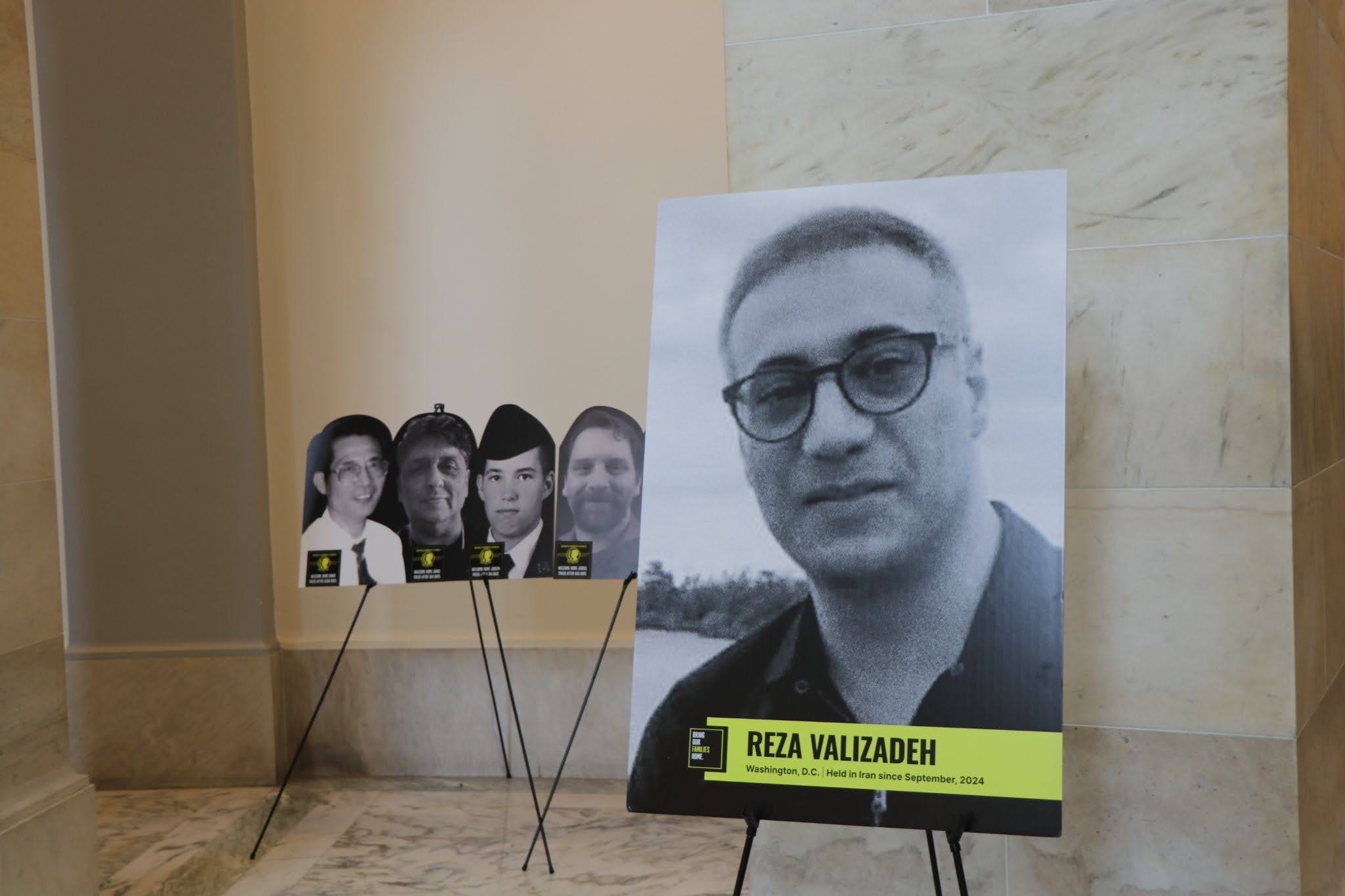
The portrait of Reza Valizadeh stands in the Senate Russell Rotunda in front of images of wrongful American detainees that the Foley Foundation has helped bring home. (Jacques Abou-Rizk/MEDILL)
The morning of Wednesday, May 6, the families of the campaign stood together in the Senate Russell Rotunda holding the portraits of their loved ones.
One of the people holding portraits was Neda Sharghi, a former chair of the campaign, whose brother returned to the U.S. in 2023 after being wrongfully detained in Iran for 5 years, convicted of espionage without a trial.
Sharghi said the challenges of individual advocacy reinforce the value of a campaign made up of families.
“Individual families generally have a hard time getting the attention of the media, senior-level officials, and the administration,” Sharghi said. “We decided that we were going to bring our voices together and advocate as a whole organization.”
While people walked through the portraits set up on easels, Congress was out of session, so no lawmakers were spotted.
“For a lot of these families, it’s the last photo they have of their loved one,” said the artist for the campaign, Isaac Campbell. “Art offers so much opportunity for storytelling and interpretation and reflection that I think it’s really the best way to meet people and remind them that these people are not political issues, they’re human beings.”
Valizadeh is among 42 Americans determined to be wrongfully detained overseas by the Foley Foundation. Because the U.S. does not publicly disclose a list of wrongful detentions abroad, the nonprofit advocacy group researches cases and maintains a list. The Foley Foundations names 16 of the 42 whose families requested public advocacy. These people hail from Florida, California, Massachusetts, Texas, New York, Virginia, Michigan, and Washington, D.C. The Bring Our Families Home campaign is a family-led initiative funded by the Foley Foundation.
The Foundation began its work advocating for American hostages and reporter safety in 2014, just 16 days after American journalist James Foley was murdered by ISIS in Syria while covering the civil war.
The concept of the portraits was meant to use the power of art and communicate the humanity behind each individual story.
One of those stories is Zach Shahin, an American businessman arrested in the United Arab Emirates in March 2008. In 2017, a Dubai court sentenced him to spend the rest of his life in prison for a white-collar crime without any evidence, according to his sister-in-law Aida Dagher. Like many families in the campaign, Dagher gave up her career and has worked endlessly to bring her brother-in-law home.
“This is his 19th year,” Dagher said. “We’ve been fighting all the time to get him out. We’re hoping the U.S. government is doing what they should, the UAE government as well. We’re hoping that now finally they will compromise, settle, whatever it takes to release them.”
Campbell said the murals are meant to make people stop to think about the scale of what he calls the American hostage crisis.
“It’s hopeful because you look at all those stickers of people coming home, and they far outnumber the people that are still in detainment,” he said. “And that could be the same result for these other families that are in detainment, and hopefully will be, that they’ll come home.”
Among those involved is Ryan Fayhee, a former federal prosecutor and board member of the Foley Foundation who now conducts pro-bono work for families of those wrongfully detained abroad. His pro bono work began with Paul Whelan in 2018, a veteran arrested in Russia for alleged espionage, before being released as part of a United States-Russia prisoner swap in 2024. He now represents Valizadeh, who is being held in Evin Prison in Tehran.
“He’d already been in Evin Prison last July when the Israeli strike targeted the prison,” Fayhee said. “With a continuing blackout in Iran and threats from the IRGC to his family, we really haven’t been able to communicate in any way, and that’s deeply concerning.”
But Fayhee expressed hope over the changing landscape of American hostage and detainee recovery over the past decade. In 2015, after Foley’s murder, President Barack Obama signed Presidential Policy Directive 30, which created the Special Presidential Envoy for Hostage Affairs and restructured U.S. policy toward terrorist negotiations. In 2020, Congress passed the Robert Levinson Hostage Recovery and Hostage-Taking Accountability Act, which codified some of the processes set up in the policy directive.
“Even from the time when I began doing work of this sort with Paul Whelan and his family… we’re just light years ahead of where we were in terms of the resources, the personnel, the engagement, the willingness to resolve,” Fayhee said.
Dagher, who lives in Texas, stressed the importance of the Foley Foundation and the campaign in bringing these families together.
“[Zach Shahin’s] wife cries every single day for the last 18 years,” Dagher said. “That’s why I left my career… But I think finally we’ll get him out. I feel that this year they will be out.”
Published in conjunction with