
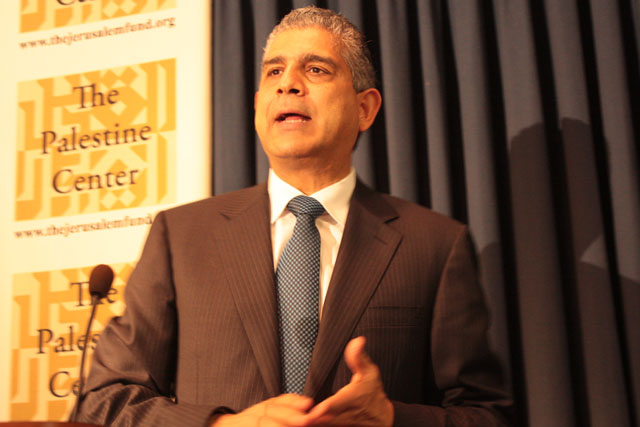
PLO representative Maen Areikat at the Palestine Center Tuesday in Washington, addressing his country's plans for admission to the U.N. in September. (Rema Rahman/MNS)
WASHINGTON – A PLO leader said Tuesday that Palestine will consider bypassing the U.N. Security Council and going directly to the General Assembly when it requests admission to the United Nations in September.
The option, if accepted, would allow Palestine to become a non-member state in the U.N. For full recognition, leaders are also considering acceptance by the Security Council first, which could postpone the process.
The first avenue is a way to “avoid any delay tactics by a permanent member” of the Security Council,” said Chief PLO Representative Maen Areikat during a panel discussion at the Palestine Center. “It has not [been] done before, but we can do that.”
There are five permanent members of the Security Council: China, France, the Russian Federation, the United Kingdom and the U.S. On Monday, a Quartet meeting – between the U.S., Russia, the E.U. and the U.N. – failed to produce a solution to reignite Israeli-Palestinian negotiations.
On July 16, the Arab League will meet in Cairo to decide the next move Palestinian leaders need to make. They must draft the U.N. request by the end of the month in order to go before the General Assembly in September.
“Any state that is peace-loving and that is willing and able to carry out the [U.N Charter] obligations is supposed to be admitted,” Ohio State University international law professor John Quigley said during the panel discussion.
Both Israel and the U.S. are concerned that this request undermines peace negotiations that they say should occur only between Palestine and Israel.
Ari Goldberg, spokesman for the American Israel Public Affairs Committee, a U.S. pro-Israel lobbying group known as AIPAC, said in an interview that by going to the U.N., Palestinian leaders were circumventing negotiations “directly between the two parties on such things as borders and refugees, nothing is likely to change for the better.”
The U.S. House overwhelming passed a resolution July 7 urging U.S. President Barack Obama to consider suspending economic aid to the Palestinian Authority if it continues to pursue statehood outside of direct negotiations with Israel.
The resolution cites the Palestinian Authority’s recent reconciliation with the radical Islamic group Hamas, recognized as a terrorist organization, as the key element for nonsupport of statehood.
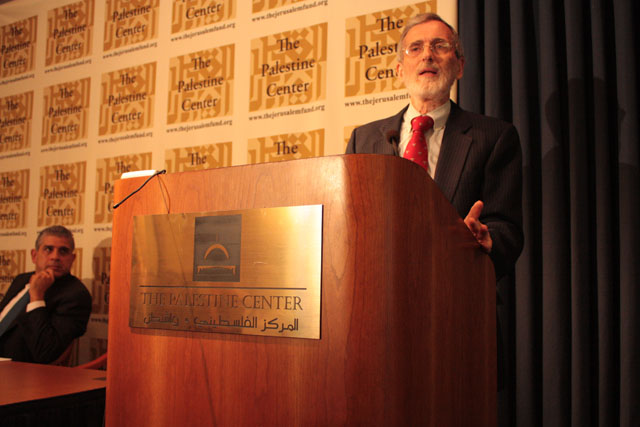
Professor John Quigley speaks about international law regarding Palestinian statehood as Ambassador Maen Areikat looks on. (Rema Rahman/MNS)
That concern is one shared by Israelis. When Israel sits down with Palestinians, they want to make sure it’s with those “who are committed to a comprehensive lasting peace agreement,” Goldberg said.
Despite Hamas having been been vocal about not living side-by-side with Israel, Areikat said all Palestinian leaders agree on the same thing – an independent Palestinian state on pre-1967 borders with Jerusalem as its capital.
Areikat said it is the PLO, not Hamas, that “will continue to be steering and supervising political issues and the issues of negotiations if and when they are resumed.”
“We are not in the business of de-legitimizing Israel,” Areikat said at the discussion. “We are in the business of legitimizing Palestine.”
“The Palestinian people are basically fed up,” Areikat said. “They are not going to allow for this status quo to continue.”
Areikat said leaders considered their options more publicly after Obama delivered an influential speech at the General Assembly last year that called for “a new member of the United Nations – and independent sovereign state of Palestine, living in peace with Israel.”
For Palestinians and Israeli’s on the ground, even if admittance and recognition is granted, it’s unlikely both sides will see an immediate change in their circumstances.
“It doesn’t do anything to improve the quality of lives of both people,” Goldberg said. “Both parties have to sit down and hammer down a final agreement.”
Still, Areikat hopes admittance and recognition by the U.N. could eventually pave the way for a peaceful solution.
“This is not a ploy. It’s not a trick. We don’t gamble with the future of our people by going to the United Nations,” Areikat said. “We are going there to deliver a very clear message: The status quo will not continue. The Palestinians are not going to accept to be under the only military occupation left in the world.”