
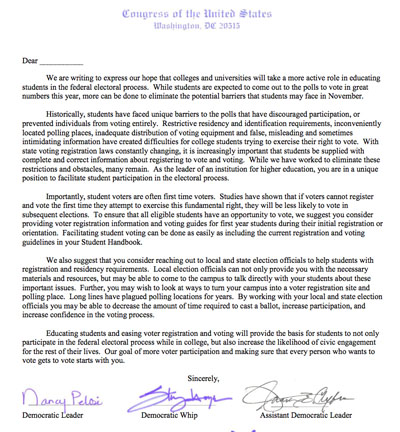
In early August, members of Congress – led by Democratic Whip Steny Hoyer – sent a letter to college and university presidents across the country asking them to help mitigate some of the barriers facing student voters.
WASHINGTON – Students around the country are swapping swimsuits and sunblock for backpacks and books as they head off to college – often crossing state borders to get there. It’s a rite of passage, but this November, their student status may cause problems at the polls for young voters.
“Many voters are essentially living in dormitories where they attend school, and some boards of election don’t consider those to be proper residences,” said Matthew Segal, president and co-founder of Our Time, a nonprofit organization that promotes youth voter rights.
This presents a problem, especially if students want to vote where they attend school.
Many students also rely on school-issued student identification cards as their primary form of identification. But that can cause troubles on Election Day, Segal said, because restrictions in state voter ID laws – like the law recently upheld in Pennsylvania – can be used to challenge the student IDs. In fact, Segal called photo ID restrictions the “number one” barrier to student voters.
The Pennsylvania law states that student IDs will be accepted at polling locations under certain conditions – they must come from an accredited Pennsylvania university, and they must list an expiration date. But many college IDs lack expiration dates, said Josh Spaulding, communications and policy manager of Campus Vote Project, a campaign to help college students overcome voting impediments.
“Pennsylvania schools are kind of scrambling right now to figure out how to go around this,” Spaulding said. “Some schools are producing expiration date stickers for IDs, and there are several others colleges and universities who plan to redo their IDs and add expiration dates.”
Spaulding is referring to the 14 universities included in the Pennsylvania State System of Higher Education, all of which have agreed to add expiration dates to their IDs to satisfy the controversial state law and make it easier for students to vote this November.
And although this quick fix may work in Pennsylvania, the state is only one of many that have imposed narrower voter ID laws. Advocates like Our Time’s Segal are looking for a more permanent solution to student voting problems. In July, Segal met with 15 members of Congress -– including Democratic Whip Steny Hoyer, D-Md. – to discuss the barriers obstructing young voters.
“The essence of the meeting was not just to focus on antiquated barriers,” Spaulding said, “but also to talk about how we can create a culture more accustomed to getting better voter turnout.”
This isn’t the first time Congress has entered the discussion, despite the fact that legislation addressing the issue has been largely unsuccessful in both chambers. In 2009, an amendment to the National Voter Registration Act of 1993 – also known as the Motor Voter Act – was introduced in both the House and Senate.
The bill, sponsored by Sen. Dick Durbin, D-Ill., Rep. Jan Schakowsky, D-Ill., and Rep. Steven LaTourette, R-Ohio, would have required all federally funded universities to offer voter registration to students during course enrollment.
The legislation gained bipartisan support, but ultimately died. Segal blamed special interest and lobbying groups, some of whom he said viewed the legislation as an “administrative burden” or unfunded mandate. “Trade associations that represent these colleges have often protested when politicians have asked them to tie in the Motor Voter concept to their colleges,” Segal said.
Despite the lack of progress, Segal called the recent meeting “a big victory” in that it showed Congress is still willing to address the issue. In fact, Segal noted, earlier this month, more than 150 members of Congress signed a letter addressed to colleges and universities across the country, asking them to take a more active role in mitigating voting barriers.
Segal said he hopes schools will take a proactive approach in the months leading up to this year’s election, especially because Congress isn’t likely to adopt legislation anytime soon. “It’s not going to be federally adopted within the next few weeks,” Segal said, “but it could certainly be implemented as a best practices agenda for colleges and universities across the country.”
Spaulding also underscored the role of colleges and universities in assisting student voters. “Probably one of the biggest things they can impart on students as part of their academic collegiate education is to be civic-minded citizens, and to actually go out and vote,” he said.