
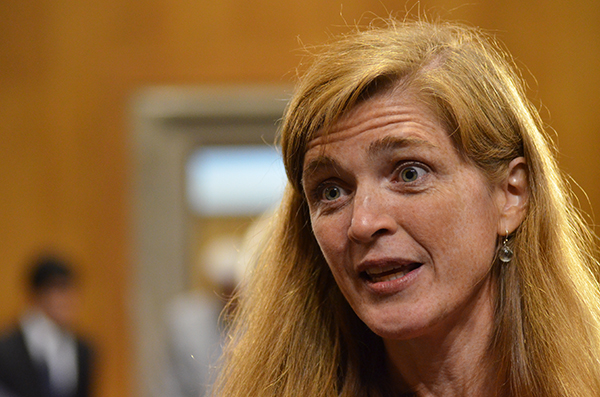
Samantha Power, in her confirmation hearing by a Senate committee said that the U.N. will explore all tools in the toolbox to stop the atrocities in Syria. (Kavya Sukumar/MNS)
WASHINGTON – Samantha Power, President Barack Obama’s nominee for ambassador to the U.N. at a confirmation hearing Wednesday, called the Security Council’s inaction on Syria frustrating and “a disgrace that history will judge harshly.”
Obama nominated Irish-born Power, a former member of his administration’s national security council, to succeed Ambassador Susan Rice as the Permanent Representative of the United States of America to the United Nations.
Her nomination on June 5 has garnered bipartisan support in the Senate Foreign Relations Committee and is expected to gain the required votes next Tuesday. Her supporters include Republican Sens. John McCain of Arizona and Robert Corker of Tennessee.
At the hearing, Power was accompanied by her husband, Cass Sunstein, and their two children.
In response to senators’ questions, Power called Syria “one of the most devastating cases of mass atrocities” that she had ever seen. She criticized the U.N. Security Council for its paralysis in reaching a decision on what action, if any, to take and said that it is unlikely that the council will approve a military intervention in the near future.
If confirmed, however, Power said she would advocate a multi-faceted approach that will bring down Syrian President Bashar Assad’s regime.
“When the Assad regime falls and it will fall, the individuals responsible for these atrocities will be held accountable,” she promised.
Outspoken human right advocate Power’s nomination sparked some controversy and criticism from various interest groups.
But at the hearing Power presented a diplomatic front. Often described as blunt and outspoken, she reined in her provocative opinions and stuck to a safe middle path when fielding questions from senators.
Sen. Rand Paul, R-Ky., asserted her responses were “non-response responses.”
Power, in a 2003 article published in the New Republic, had recommended that the U.S. apologize to the world for its past failures as a way of building America’s credibility among other nations.
“I believe America is the greatest country,” Power said Wednesday when Sen. Marco Rubio, R-Fla., asked her to enumerate the crimes she thinks the country should apologize for. “I will not apologize for America.”
She had also come under fire from pro-Israel activists for her remark in 2002 in an interview with Harry Kreisler of the Institute of International Studies at Berkeley, Calif. She said then that the U.S. might have to deploy a “mammoth protection force” to invest in a new Palestinian state.
At her hearing Wednesday, she dissociated herself from that statement and called it a “remarkably incoherent response to a question I should have never answered.”
Power, a self-styled “humanitarian hawk”, had also in the past remarked that the U.S. has a responsibility to stop human rights violations across the world. This stance gained her critics like former Rep. Allen West, R-Fla.
“I don’t want someone to be in a position that sees [people in uniform] as [people] they could throw into a meat grinder for some really distorted, misguided view and perspective of human rights and humanitarian assistance,” West said earlier this month at an event organized by Center for Security policy, a Washington-based conservative, pro-defense interest group.
Center for Security Policy sent a letter signed by nearly 50 pro-Israel activists and foreign policy experts urging senators to reject Power’s nomination.
Adam Savit, program manager at the center, dismissed Power’s change on Israel as a “P.R. exercise.” Savit said, “She gave lip service to popular opinion and stuck to bland middle of the road rhetoric.”
Power, the Pulitzer Prize winning author of “A Problem from Hell: America and the Age of Genocide,” has taught foreign policy at Harvard’s Kennedy School of Government. She was a special assistant to Obama and also served on the National Security Council.
In the month of July, the U.S. representative to the U.N. presides over the Security Council, an opportunity that comes by once every 15 months. The interim ambassador Rosemary DiCarlo is handling that responsibility while Power awaits her confirmation.
Foreign Relations Committee Chairman Robert Menendez, D-N.J., said his panel will move quickly on Power’s nomination so that she can preside over the council.
Members of the committee are expected to vote on her nomination next Tuesday, clearing the way for action by the full Senate.