
How do you lose $33 million in three months?
If you’re PepsiCo, redesign the prominent Tropicana orange juice packaging.
Tropicana rolled out a simple, modern design in 2009, but juice drinkers weren’t craving the new look. Sales of Tropicana Pure Premium orange juice fell 20 percent, according to the company’s 2009 SEC filings. And it was widely reported that PepsiCo quickly reverted to Tropicana’s old design because of the dropoff. The lesson learned applies to all businesses: don’t mess with something that works.

PepsiCo released modern new packaging (right) for its Tropicana orange juice in 2009, but quickly reverted to its old design (left) as sales dropped 20 percent in one quarter. (Courtesy of J. Lai)
Companies have been rebranding for decades in hopes of perking up their sales. But for many, it’s done the opposite. So what makes or breaks a rebrand?
Marketing experts say the redesign must happen for the right reasons and symbolize a transition in the company—not just the packaging.
“It’s very rarely done for aesthetic reasons and almost always done to strengthen the business to compete better with rivals or to signal a change in the direction of the company, like a merger, acquisition or spin-off,” said Eric Thoelke, president and executive creative director of TOKY, a marketing firm that has worked for Panera Bread and National Geographic.
Companies may also choose to redesign their brand if they’re expanding their product offering or target audience.
However, if a business is rebranding for the sake of a fresh look, it’s usually a sign there’s not enough investment in the project to make it successful, Thoelke said in an email exchange.
And rebranding requires quite a bit of investment. While consumers may just notice a new logo, there’s much more happening behind the scenes.
“Although a strong logo is certainly important, it won’t alone change the overall identity of a brand,” said Marc Bowers, creative strategist for the Sutter Group. “For that, you need much more.”
A new logo should symbolize a change in the company’s values or purpose. But according to Bowers, that’s where many businesses fail, mistaking a new logo for a brand refresh — and not changing anything else. The company’s actions and policies should change similarly.
British Petroleum is a example. Despite the green sunburst flower logo that the firm adopted in 2000, many consumers no longer consider BP an environmentally-friendly firm after the oil gusher in the Gulf of Mexico in 2006.
“Their attempt at positioning themselves as a very green, earth-friendly corporation helped make the public perceive them as a leader in green tech — at least until the Gulf disaster,” said Thoelke. “A logo can only go so far. It’s far more important that your actions match your public relations.”

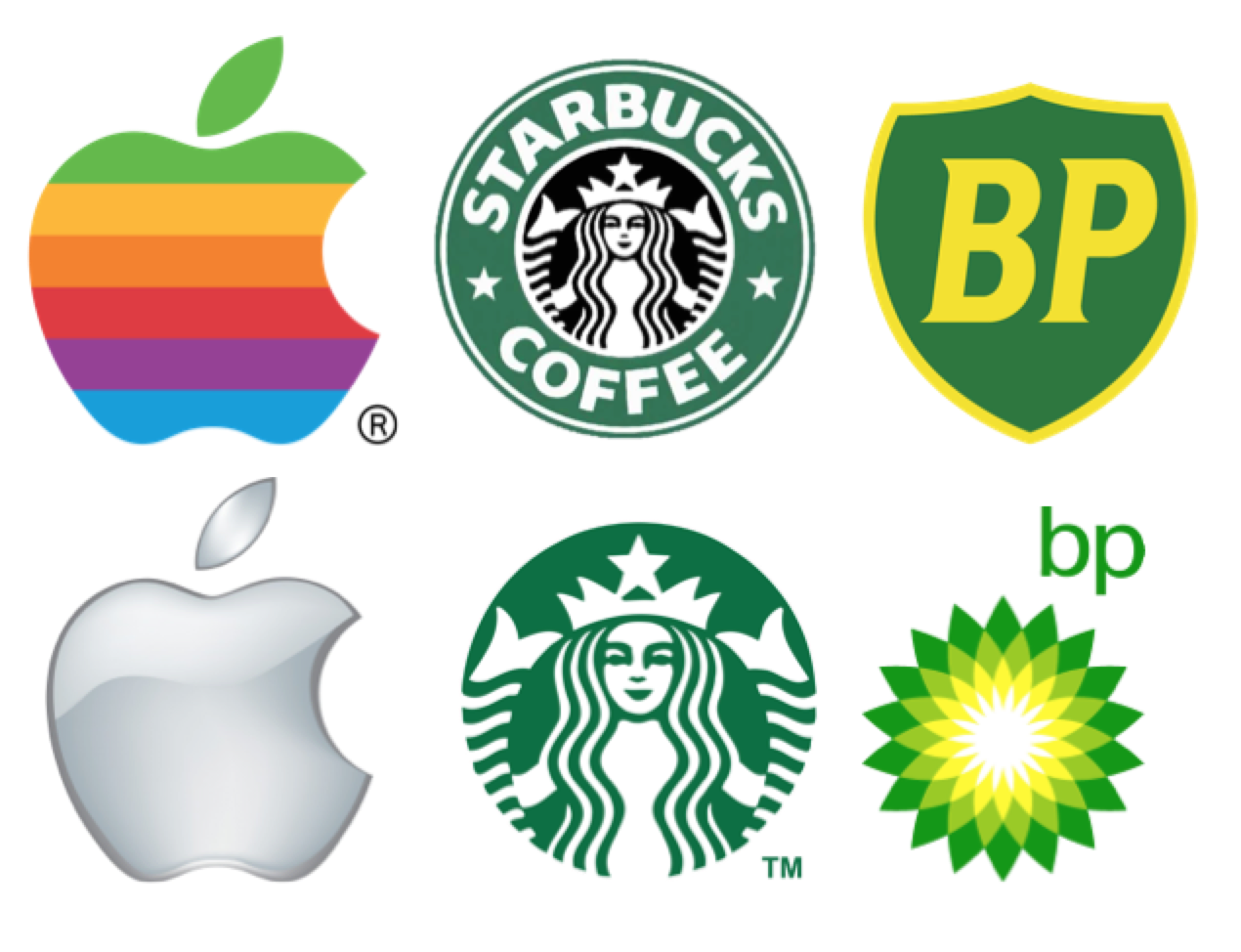
BP logo from 1989 – 2000 (Courtesy of BP)
Current BP logo (Courtesy of Lou Gold)
After the government demanded BP pay $41 billion in recovery costs, the company reported its first annual loss—of $4.9 billion—since 1992. Though BP’s failure wasn’t the result of a mishandled redesign, the company’s losses show there’s much more to rebranding than simply a logo.
But simply redesigning a logo costs a fortune—something many companies don’t take into account before beginning a redesign.
“Companies who rebrand often don’t realize the great investment they’ve made into all kinds of infrastructure, from their fleet of vehicles to their Facebook page, from their signage to their stationery,” said Thoelke. “A rebrand means there’s going to be a cost to inventory all of that, to take it all apart and to redesign and reinstall, reprint or relaunch everything.”
There’s also the cost of hiring a rebranding consultant and a huge investment in time, research and creativity.
But even if a company does everything right, marketing experts warn the transition probably won’t go smoothly. Most companies, ranging from Fortune 500 Starbucks and young startup Airbnb, receive negative backlash when they released new logos.
Airbnb logo from founding in 2008 – July 16, 2014 (Courtesy of Wikipedia)

Current Airbnb logo (Courtesy of Airbnb)
“Resistance is almost a guarantee, especially when you’re dealing with a big name brand,” said Bowers. “Starbuck’s most recent rebrand, which included the removal of its name from its logo, was met with significant backlash; yet Starbucks continues to grow and thrive.”

Starbucks logo from 1992 – 2011 (Courtesy of Makipapa)

Current Starbucks logo (Courtesy of Makipapa)
With so many failures and challenges, rebranding may seem too great a risk. But Apple’s experiences demonstrate just how profitable a successful rebranding can be.

Apple logo in 1997 (Courtesy of Olivier Anh)

Current Apple logo (Courtesy of Olivier Anh)
In 1997, Apple was operating at a loss and competitor Microsoft was winning the market. When Steve Jobs rejoined the board in August of that year, the company’s stock was selling at 77 cents. In 1998, the company introduced the iMac—an aesthetically appealing, functional computer—and a sleek new logo to match. New products and refreshed branding have kept Apple at the forefront of the industry, and today shares are selling for more than $100.
“Do it right, and the results can be powerful,” Thoelke said.
Published in conjunction with