
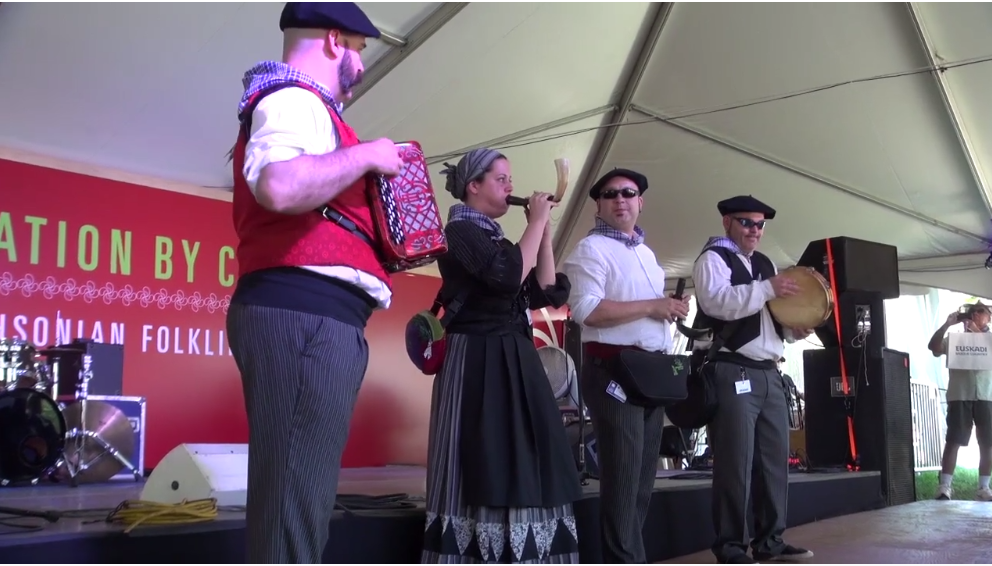
WASHINGTON – The Basque area in northern Spain and southwest France has a unique culture that has withstood much hardship; Basques who settled in the U.S. are continuing the traditional dances and language, which are being celebrated at this year’s annual Smithsonian Folklife Festival.
Basques have emigrated all over the world, with large populations now living in the western U.S. states like California, Idaho and Nevada – where the Basques could continue their sheep herding practices in pockets of fertile, sprawling land.
Cristina Diaz-Carrera, curator for the Smithsonian Center for Folklife and Cultural Heritage, said she was surprised to learn in her research that there was such a thriving population of Basques in the U.S.
“In California, there’s the biggest population of Basque Americans in the United States, and we’re really happy to bring that community here to present their traditions,” Diaz-Carrera said.
Christian Jaureguy, 24, of Chino, California, is performing at the festival to dance with his Gauden Bat dance group. He said that Basque natives and Basque Americans alike maintain a strong connection.
“Our Chino community meets once a month to do a dinner together and we celebrate, we have a festival two times a year,” Jaureguy said. “It’s different – a lot of people don’t have what we have, it’s almost like an extended family.”
The Basque country, nestled in northern Spain and southwest France, maintains a cultural tradition that spans centuries. Its language is one of the most unique and intriguing aspects of Basque culture. According to the Smithsonian website, Basque shares no origins with any other European languages, apparently predating Indo-European language structures. But it had all but disappeared in the 1960s under Francisco Franco’s dictatorship. Thanks to revitalization efforts in the 1980s, Basque language schools started popping up in the region.
Xabier Paya, 33, of San Sebastian, Spain is a Basque poet participating in the two-week-long festivities. Though his parents did not grow up learning Basque, they instilled in him a desire shared by many during that time to keep the language alive.
“In San Sebastian for example in the ’80s, two children only out of 10 could know speaking Basque. Nowadays two out of 10 don’t speak the language,” Paya said.
Published in conjunction with 