
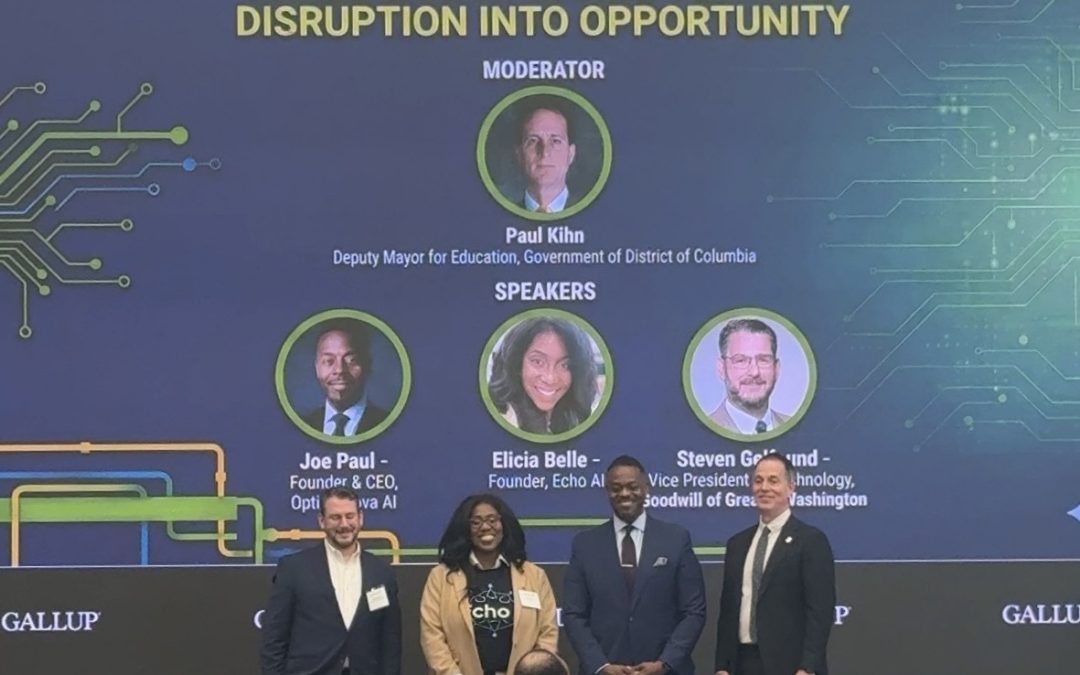
WASHINGTON–Panelists at the DC Chamber of Commerce’s inaugural “Future Ready Forum” on Thursday had a message for business leaders worried that artificial intelligence could replace workers and cut jobs: adopt AI or get left behind in the dust.
“Not only is (AI) unavoidable, the organizations who don’t adopt now may cease to exist in the future,” said Joe Paul, founder and CEO of OptimaNova AI, a D.C.-based artificial intelligence consulting firm and one of the forum’s panelists. “You have to make room for AI. The train has left the station, so you have to run out and catch up and get on.”
Research released by Goldman Sachs this month showed that AI was beginning to show up in unemployment reports, reducing monthly payroll growth by about 25,000 jobs and raising the unemployment rate by 0.16% over the past year.
The Trump administration has taken a solid pro-AI stance, emphasizing deregulation and private-sector innovation to establish U.S. economic competitiveness.
Last month, Trump unveiled a six-point national legislative framework addressing common concerns around AI, including the protection of minors and the defense of intellectual property rights.
More Americans are using AI in their day-to-day work, with a Gallup study released last month reporting that 43% of public-sector employees and 41% of private-sector employees use AI in their roles — numbers that have more than doubled since the middle of 2023.
Despite rapid integration, concerns about the technology’s potentially detrimental impact on the environment and employment numbers linger. A Pew Research Center survey published in September found that 50% of Americans are more concerned than excited about AI, compared to just 37% in 2021.
But Elicia Bell, a panelist and founder of AI training and deployment firm EchoAI, said that integrating AI technology into a company’s workflow does not need to equate to layoffs.
“Instead of thinking of the roles that were kind of rote functions like answering the phone, sending emails, think of the fact that a person still has a whole universe between their ears, of ideas, intellectual property,” she said. “So don’t throw away or lay off your workforce, because you’re really just letting all that intellectual capital go out on the street.”
Still, activist grassroots movements like PauseAI, which call for a halt in AI developments until regulatory guardrails are set in place, cautioned against businesses jumping to adopt the technology into their day-to-day operations.
“The capabilities of AI change by the day, and if you integrate a current model today, you’re still going to be outpaced probably very soon,” said Holly Elmore, executive director of PauseAI’s U.S. chapter.
LeeAnn King, one of the forum’s attendees and founder of strategic management service company Resonant Movement, raised the issue of AI data centers’ harmful effects on the environment, citing massive energy consumption and high water usage.
King, who has degrees in environmental science from the University of Maryland, said there was still a lack of answers surrounding the question of how businesses can use AI responsibly to minimize damage to the earth.
“I don’t think that we have a lot of regulations in place,” she said. “There are some issues that have come up in committees and discussions are happening, but nobody really has any answers yet on how the regulations are going to be implemented and enforced.”