
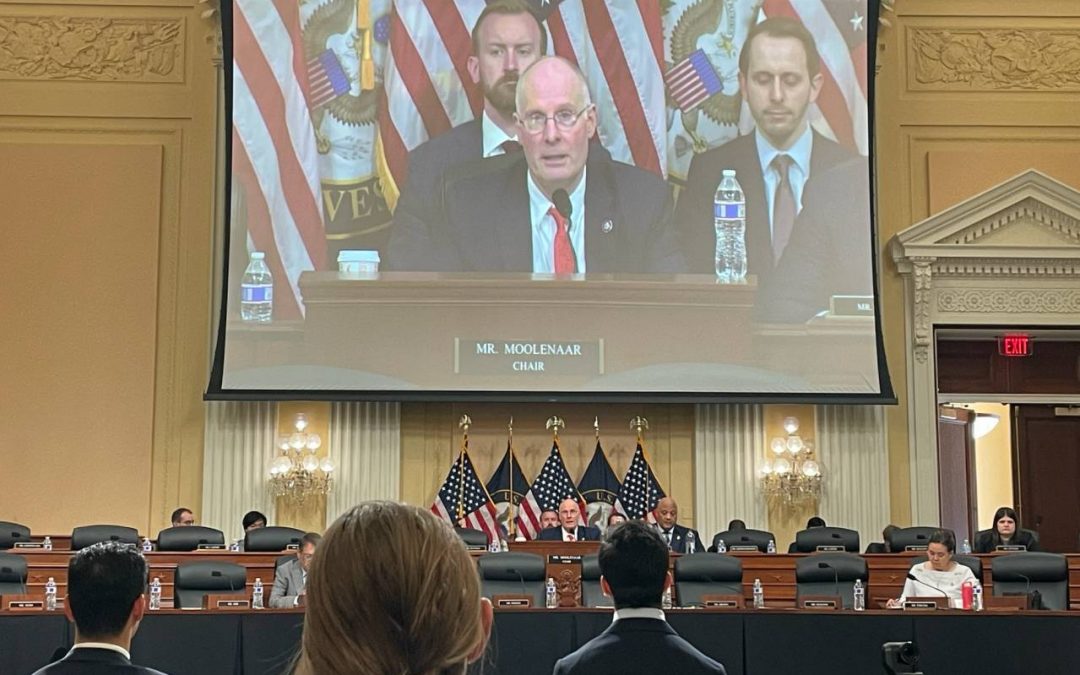
WASHINGTON — Tech experts warned a congressional committee on Thursday that China is stealing American AI technology and plagiarising it, as House lawmakers grappled with how to slow the threat.
The Select Committee on the Chinese Communist Party convened for the hearing a month after the Justice Department announced a $2.5 billion chip smuggling case. Chairman John Moolenaar, R-Mich., called it “the largest export control violation in U.S. history.” Alleged actors included California-based Super Micro Computer, Inc. cofounder Yih-Shyan “Wally” Liaw. Moolenaar said smugglers used a hair dryer to remove Supermicro serial-number labels and placed them on fake server boxes to fool enforcement officers into believing the chips remained in Southeast Asia when they had already been moved to China.
“China’s smuggling of advanced AI chips is a pervasive threat,” Moolenaar said in his opening statement. Moolenaar’s office declined an interview request after the hearing, directing Medill News Service to his prepared remarks.
Witnesses warned that China is advancing its AI ambitions by illicit chip procurement and by using AI models to extract American technology at a fraction of the original development time and cost.
Alaap Shah, co-chair of Epstein Becker Green’s AI Practice Group, said that the threat goes beyond hardware. “China is very good at stealing secrets and reverse engineering innovative technologies,” he said.
He noted that China has attempted to attack and reverse-engineer leading American large language models, such as ChatGPT or Claud.
But Giulia Neaher, an AI policy research analyst at the Stimson Center’s Strategic Foresight Hub, cautioned that trade restrictions alone would not secure U.S. dominance in the AI industry. “The bulk of the economic impact of AI doesn’t matter what the capabilities are if people aren’t using it,” she said.
Witness and chairman at Silverado Policy Accelerator Dmitri Alperovitch told the committee that if the United States, the Netherlands and Japan continue supplying China with semiconductor manufacturing equipment, Beijing could eventually reduce its dependence on foreign chip supply entirely. He also noted that U.S. export control forces China to face restricted supply, making the embargo on chips the biggest problem for Chinese AI companies.
Yusuf Mahmood, another witness and director of AI and emerging technology at America First Policy Institute, pointed to the Linwei Ding espionage case as evidence. He mentioned that China is systematically targeting the U.S. AI assets and said that safety guardrails built into American models can be stripped away with relative ease once a model is obtained. He added that 38% of the country’s top AI researchers received their undergraduate education in China, underscoring the depth of Beijing’s talent pipeline.
Rep. Greg Stanton, D-Ariz., noted that his state, home to Intel and Taiwan Semiconductor Manufacturing Company facilities, is rapidly becoming a major semiconductor manufacturing hub. But he cautioned that the United States still depends heavily on overseas supply chains for critical chip packaging technologies, a gap he said Congress must address.
Kyle Chan, a fellow in the John L. Thornton China Center, Brookings Institution who testified at the hearing, pushed back against framing the competition too narrowly. Chan said the debate in Washington focused excessively on frontier models and not enough on making AI work for ordinary Americans.
“It is not just about having the most powerful models, but about making AI work for American people,” Chan said in a brief interview after the proceedings.
He expressed other concerns raised during the hearing about job displacement, rising energy costs and deepfakes in local communities.
Chan also cautioned that an expansion of export controls could trigger a retaliatory response from Beijing. He called for broader conversations with Chinese counterparts, about biosecurity, AI in the military and the dangers of open-source models falling into the wrong hands of non-state actors. He noted the progress could hinge on an anticipated summit between President Donald Trump and Chinese President Xi Jinping.
Chan said the core policy challenge remained unresolved, and the Congress still had to determine who should govern AI development in America, and whether that power belongs with private companies or the public.
“A lot of these rules are actually being decided by private companies,” he said. “Some of that power and responsibility needs to go back to the people who are affected.