
WASHINGTON –On Aug. 31, 2006, Kevin Ivory was exposed to three roadside bombs in Fallujah, Iraq. The third blast left him unconscious for 26 hours, during which he had no memory of what was happening to him.
Ivory, who was an E4 petty officer 3rd class in the Navy, spent four weeks at the Balad Air Force Base Hospital in Iraq before he flew back to the U.S. There, he worked on cognitive and speech skills while his migraine symptoms were controlled.
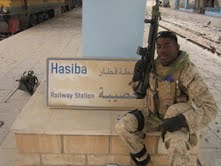
Kevin Ivory during his service in Iraq.
When he returned home to Scottsdale, Ariz., he entered care at the Veterans Affairs Polytrauma clinic in Phoenix. Doctors there set him up with a psychiatrist to treat his post-traumatic stress disorder as well as a speech therapist and a neurologist for his traumatic brain injury.
“They really allowed you to manage your own care and help the physicians help you,” said Ivory, who recovered enough to stop full-time treatment in 2009. “I was given options and I was able to choose the best options that I felt fit for me. I think that the care was really perfect in my eyes because I had my hand in a lot of it.”
A polytrauma center is a specialized rehabilitation center located within a larger hospital that focuses on traumatic brain injury and combat exposure, as well as PTSD, a psychological disorder characterized by anxiety and flashbacks of traumatic events.
Seeking treatment at a polytrauma rehabilitation center rather than a more general VA hospital is especially important for service members with severe injuries, said Dr. Shane McNamee, the chief of physical medicine and rehabilitation service at the Hunter Holmes McGuire Medical Center in Richmond, Va.
“Somebody who has sustained multiple blasts and has severe psychological problems, or a severe blast and has multiple amputations and traumatic brain injury and all the things associated with that, they’re going to do a lot better at a polytrauma rehab center than somewhere else,” McNamee said.
Doctors told Ivory that he would receive the best treatment at the polytrauma clinic at the Phoenix facility because of the extent of his injuries. While Ivory felt he was well-cared for at the VA, getting to the care proved a little difficult.
“Sometimes it was a little bit hard getting appointments because there are so many people coming back with injuries,” said Ivory, who is now 26.
Sen. Max Baucus, D-Mont., introduced a bill in March that would build a new polytrauma center either at Fort Harrison in Helena or at another site in the Northern Rockies or Dakotas. Veterans in that area are now unable to access the specialized care available at polytrauma rehabilitation centers because they would have to travel too far to reach the nearest one.
“Brain injuries take a toll on our veterans and their families and that burden becomes even greater when troops have to travel long distances to get the traumatic brain injury care they need,” Baucus said in a press release about the bill.
Almost 10,000 members of the military suffered traumatic brain injuries while serving during the first five months of 2011, according to the Defense and Veterans Brain Injury Center. McNamee said that many will also experience psychological problems like PTSD that would be addressed at a polytrauma center—something that doctors used to treating athletes may overlook.
“The difference is its context. When you get a concussion playing football, you’re playing football. You go to the sidelines, you get evaluated and you rest for a certain period of time,” he said. “But when you’re exposed to a blast, you’re in combat. There are some pretty horrible things happening around you at that time to the people that you love.”
At Phoenix VA polytrauma clinics, Ivory was given the tools he needed to combat his PTSD as well as ways to remember everyday tasks that might escape him.
“I used to forget to brush my teeth in the morning and stuff like that,” he said.
Though he has made improvements, Ivory, who is now a personal body guard, still struggles with memory loss and stutters if he speaks too fast.
“I can’t say that I’m fully recovered,” he said. “I could function the whole time but it was definitely something I had to be conscious of as far as my speech and everything else. So yeah it took a little bit of time.”
