
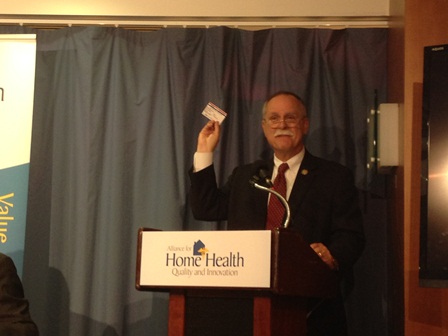
Republican Rep. David McKinley shows his Medicare Benefit card at a news conference.
WASHINGTON – A report by a health care advocacy group released Wednesday found that the Medicare program could save up to $100 billion in the next 10 years with proper restructuring, including minimizing unnecessary hospital admissions
The Medicare Part A Trust Fund, which was designed to pay for hospital insurance, could be extended by two and half years with the $100 billion saved from hospital admission fees, found the report, commissioned by the Alliance for Home Health Quality & Innovation and conducted by Allen Dobson, a health economist and lead researcher
“Our country’s Medicare program needs major reforms for it to remain sustainable for the future generations and to be strengthened for seniors that are benefiting from it today,” said Rep. David McKinley, R-W.V.
McKinley was joined at a National Press Club news conference by former Republican Rep. Billy Tauzin of Louisiana and former Democratic Sen. Blanche Lincoln of Arkansas.
Medicare episode payments are more than double when a beneficiary’s care includes hospital admission, the report found.
The annual health care expenditure is roughly $2.7 trillion, and “with 10,000 participant adding every day, the Medicare trust fund may become insolvent in 2024, some are even suggesting it’ll be as soon as 2017,” McKinley said.
Tauzin said the government needs to find a way to make Medicare more cost-effective while maintaining the quality of health care.
“Why would American taxpayers or Medicare tax contributors pay for systems that always place patients in an inappropriate setting that’s also expensive and unnecessary,” Tauzin asked. “You can’t just shift people to the lower cost settings without regarding what’s appropriate. That would be bad for patients and bad for the Medicare system.”
Lincoln said both beneficiaries and policymakers need education to accomplish the economic goal of saving the Medicare budget.
“Most people in Washington, unless you have been a caregiver, you don’t necessarily understand those pathways. We have got to create a better understanding of that,” Lincoln said.
The report also found there is an overlap of patients across post-acute care settings, Dobson said. He suggested Medicare could save by understanding the patterns with which patients receive care, identifying ways to avoid unplanned readmissions and placing patients in the most-clinically appropriate and cost-effective settings.
McKinley told a story about keeping his mother at home at the end of her life to make his point.
“This isn’t an easy decision, but it’s more about what’s best for her and what’s best for us,” he said. “I knew that my mom received the best care that we could give her and that she didn’t have to go back and forth to the hospital. The quality of her life and the dignity by which she was treated by her caregivers were immeasurable.”