WASHINGTON — A senior U.S. military commander reassured senators on Capitol Hill Tuesday that the war in Iran had not detracted from operations in the Indo-Pacific or interfered with the U.S.’s ability to deter adversaries in the region.
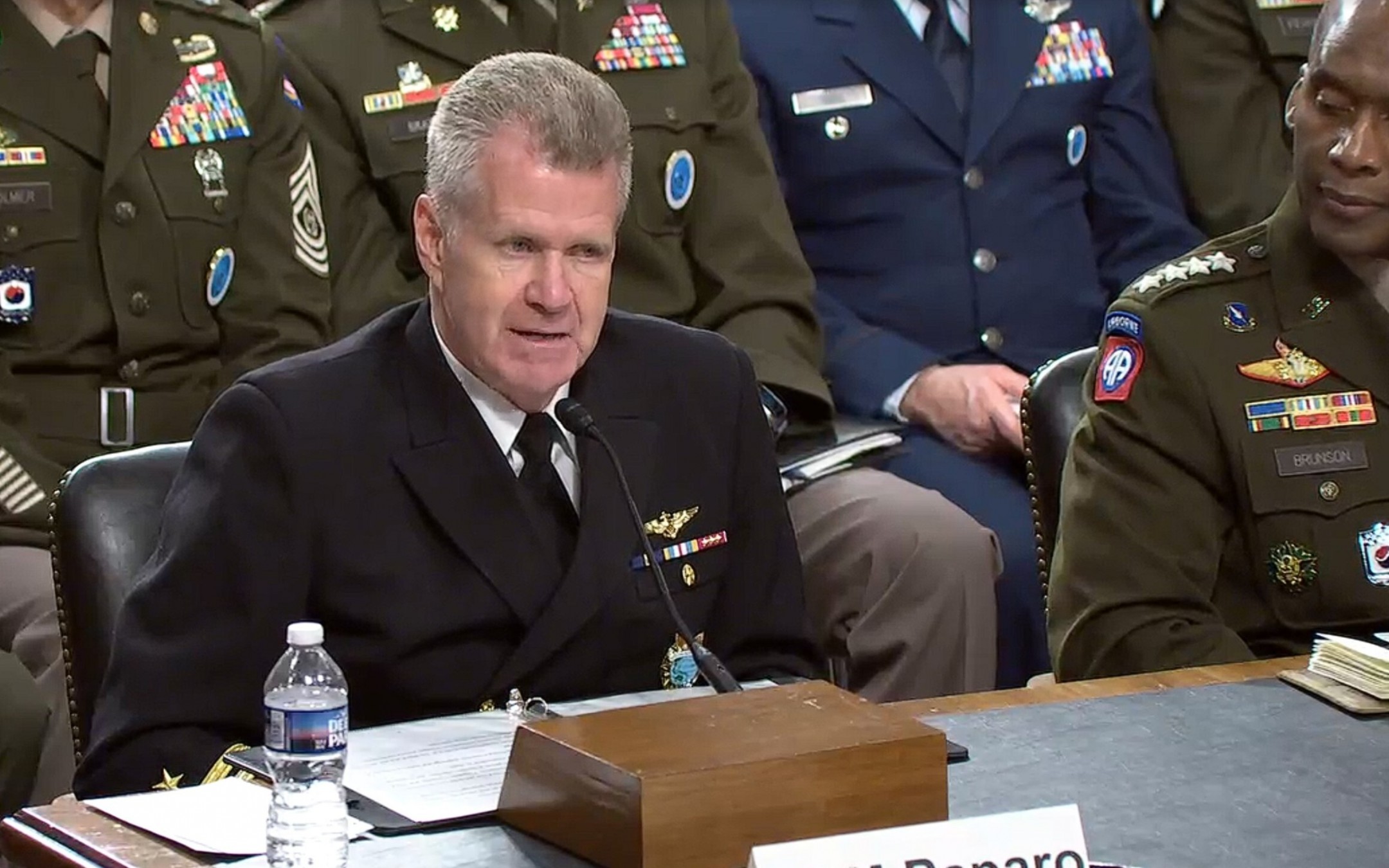
Admiral Samuel Paparo, commander of U.S. Indo-Pacific Command, the U.S. military command that oversees the Indo-Pacific region, appeared before the Senate Armed Services Committee alongside General Xavier T. Brunson, the commander of United States Forces Korea.
A common line of questioning in the wide-ranging hearing, particularly from Democratic senators, concerned how U.S. military operations in Iran have diverted resources away from the commanders’ areas of responsibility, thereby hurting the U.S. military’s ability to project power in the region.
“President Trump’s war of choice in Iran has resulted in significant military posture changes in the Indo-Pacific region and on the Korean Peninsula,” said Sen. Jack Reed, the top Democrat on the committee, in his opening statement.
Reed asked Paparo how long it would be before Indo-Pacific Command would feel the effects of a severe munitions shortage if the U.S. were to resume its bombardment of Iran at the rate seen before the current ceasefire.
Paparo said there are “finite limits” to the munitions stockpile. “I have all the faith in the world that they are being employed judiciously,” he said.
Although President Donald Trump extended the ceasefire with Iran just hours before it was set to expire Tuesday, the break in the fighting remained tenuous. Still, the fierce U.S. bombing campaign that started in late February has taken a toll on the Pentagon’s munitions stockpile. The U.S. military has expended more than 850 Tomahawk cruise missiles in the Iran war alone from an estimated prewar inventory of 3,100, according to a report released Tuesday by the Center for Strategic and International Studies. The 2026 U.S. defense budget funds the purchase of only 57 more units of the multi-million-dollar weapon.
A similar depletion of weapons stocks extends to other advanced ordnance and air-defense munitions. In an analysis of seven key U.S. munitions including the Tomahawk, the report concluded that the U.S. maintains a sufficient stockpile for any plausible scenario with Iran. But it warned that the war’s toll on stockpiles had created a risk that the U.S. will be constrained should a future conflict arise with a more capable adversary like China. Preventing and preparing for such a war is a top mission of U.S. Indo-Pacific Command.
In late 2024, Paparo responded to questions about the effect U.S. weapons shipments to Ukraine and Israel had on his command. That time, Paparo had a starker warning.
“It’s now eating into stocks, and to say otherwise would be dishonest,” he said then to an audience at the Brookings Institution in Washington. He was specifically concerned with the loss of munitions for the U.S. Patriot air defense system. That same air-defense system had its munitions stockpiles reduced by half in the Iran war, according to the CSIS report.
But on Capitol Hill Tuesday, Paparo voiced unequivocal support for U.S. operations in Iran. He qualified that his command had been forced to move resources and personnel around to account for the war — for example, the recent deployment of the Okinawa-based 31st Marine Expeditionary Unit to the Middle East. But he was adamant that rather than showing China an open door, victory in the Middle East would have a deterrent effect by demonstrating the tactical superiority of American forces.
“There is no substitute for prevailing on the battlefield,” he said.
In its 2026 annual threat assessment released in March, the U.S. Intelligence Community concluded that Chinese leaders do not plan to execute an invasion of Taiwan in 2027, a contingency long feared by the U.S. national security establishment. But the report does not confront the question of how the war in Iran, and the diversion of U.S. military resources out of the Pacific, could affect Chinese President Xi Jinping’s decision to use military action against the island.