
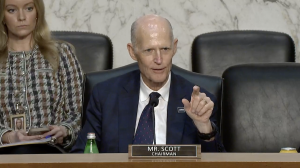
Rick Scott addresses the witnesses at the Senate Committee on Aging hearing about older adult financial literacy. (Photo from the Senate Special Committee on Aging Facebook recording.)
 WASHINGTON — In recent years, scammers have increasingly targeted older Americans for their money. Today, older adults are losing billions annually to these scams, many of which seem legitimate, witnesses told a Senate hearing Wednesday.
In 2024, U.S. citizens aged 60 and over lost nearly $2.4 billion to financial fraud according to the Federal Trade Commission. But, since many cases of fraud go unreported, the FTC estimates the true number to be between $10.1 and $81.5 billion.
“The scale of today’s scams requires a strategic, coordinated, national response,” Sam Kunjukunju, vice president of consumer education at the ABA Foundation, said at the hearing. “America needs a nationwide education campaign.”
In response to these scam attempts, the Senate Committee on Aging held a hearing Wednesday to discuss with witnesses ways to educate older adults about financial literacy.
Sen. Kirsten Gillibrand, D-NY, gave suggestions to older adults on how to avoid scams.
“Don’t click on things that you don’t recognize. Talk to loved ones,” Gillibrand said. “If someone’s asking you to wire some money or send some gift cards or send some cryptocurrency in an ATM, call a loved one. It’s nothing to be ashamed of. These are highly sophisticated criminal networks that are trying to steal your money.”
By 2026, most Americans have likely experienced receiving a scam call or email. According to the Pew Research Center, 73% of U.S. citizens experienced scams last year. While older adults were less likely to send money to scammers, they lost far more money on a yearly basis than younger consumers.
Since 2020, the total reported monetary losses to fraud impacting seniors has increased by 300%, partly because scammers requested more money than in previous years.
According to Kunjukunju, the top three types of scams impacting older adults are investment oriented, tech support and romance scams.
Kunjukunju asked Congress to craft legislation that would allow banks to delay transactions from older adults’ accounts when bankers suspect financial fraud.
“I think all of us, almost every age now, are getting targeted by fraud, owners, text, phone calls and all sorts of stuff,” Sen. Rick Scott, R-FL, said in an interview. “But seniors often don’t feel comfortable calling somebody. They’ve been on their own. We’ve got to make sure there’s legislation that helps them, [and] we are going to try to do that.”
The Senior Security Act of 2026, sponsored by Rep. Andy Kim, D-NJ, would create a Senior Investor Taskforce within the Securities and Exchange Commission, which would report on topics impacting investors over 65. It would also require the Government Accountability Office to report on the financial exploitation of seniors.
“Scammers are preying on our seniors, stealing billions of dollars from Americans’ hard-earned retirement savings,” Kim said last month in a press release introducing the bill. “Aging with dignity and security shouldn’t be too much to ask for in our country. We need this legislation and task force to take targeted and thorough action to confront these crimes and stand up for our nation’s seniors.”
The House and Senate introduced a total of seven similar acts over the last 10 years, though none have passed beyond the House.
While a national education system doesn’t exist, many resources do. The Senate Committee on Aging released the 2025 Fraud Book to help inform U.S. citizens about scams. Groups like the Financial Industry Regulatory Authority have programs to inform older adults, such as the Financial Intelligence Fusion Center, and AARP hosts a free hotline specifically for victims of fraud.
Carly Roszkowski, vice president of financial resilience at AARP, said it’s important to have a captive audience when informing older adults about financial literacy.
“We need to be meeting people where they are,” Roszkowski said. “We know that a one and done approach is not enough, and that there are important transitions that older adults are experiencing, and to have that financial education along the way … is so critical.”
Roszkowski said education needs to happen at times that are convenient, such as when older adults begin to set up retirement accounts, near retirement or claim Social Security benefits. Location such as workplaces are also important for education.
“Financial literacy works, but only when it’s practical, sustained, timely, and paired with decision support,” Roszkowski said in her testimony. “Research consistently shows that financial knowledge can lead to better outcomes, but knowledge alone is not enough. People need step-by-step, plain-language guidance that helps them act at key moments.”
Kunjukunju said the American Bankers Association Foundation launched the Safe Banking for Seniors campaign in 2016, which allows bankers to educate seniors in their local communities through presentations and workshops. This education is also for caregivers, who can help with noticing signs of fraud.
Kunjukunju said some of the signs bankers are told to look out for in their older customers include changes in demeanor, changes in transaction history, or changes in the amount of money withdrawn.