
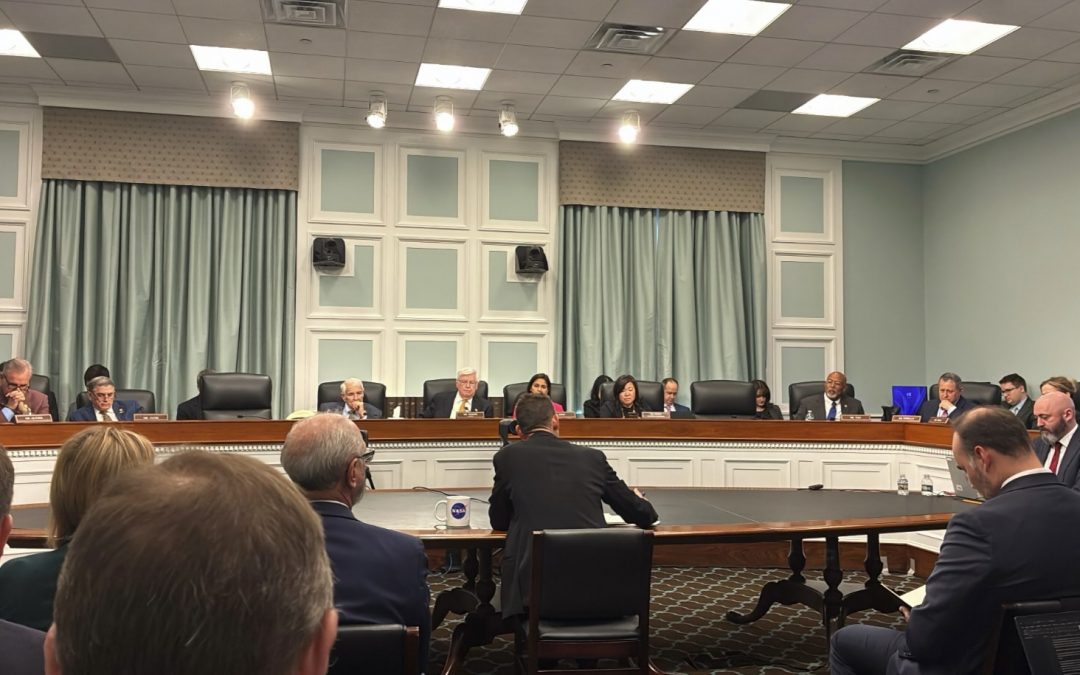
WASHINGTON — NASA administrator Jared Isaacman faced pushback from representatives on Monday about the iconic agency’s proposed hiring strategy, which would shrink public service opportunities for the younger generation.
Isaacman said earlier this week that he plans to move contractors in-house and hire from private industry, at a Commerce, Justice, Science, and Related Agencies subcommittee meeting. The space agency has held cultural relevance and national pride ever since President John F. Kennedy declared in a 1961 speech the goal of landing a man on the moon by the end of the decade. In the 1960s, the space race was against the Soviet Union. Now, representatives argue America is in competition with China.
Rep. Glenn Ivey, D-Md., asked how Isaacman planned to attract talent to NASA under the president’s budget request. The budget request suggested reducing NASA’s budget by $5.2 billion, a 23% cut.
Isaacman said 75% of NASA’s workforce is contractors and that moving the contractors in-house would be cost-effective. Another aspect of the “workplace initiative” is hiring subject matter experts from industry, Isaacman added.
“NASA is not the only game in town,” he said. “We got companies that can land rockets on ships, bring them in for term-based appointments, one, two, three years to grow the young talent inside NASA and vice versa, provide opportunities for them to go to industry and learn as well.”
Rep. Joe Morelle, D-N.Y., asked how NASA plans to support young talent.
“You just talked about this need for innovation, bright minds to be engaged, to be excited about joining in this mission, that in many ways the administration seems to want to undercut this drive to having young people engaged in science,” Morelle said. “I’m really concerned about it, so help me feel less anxious about the administration’s efforts to undermine science, broadly.”
Isaacman responded by stating that Trump created the Artemis program during his first term, and Artemis II’s success would inspire young people.
Artemis II was a crewed mission from April 1 to April 11, transporting humans to the moon for the first time since 1972 during NASA’s Apollo 17 mission.
“That causes people to pause and take notice, and I guarantee you that after Artemis II, you’re going to have more children dressing up as astronauts for Halloween,” Isaacman said.
Morelle added that he was worried about how NASA could expect scientists to work there 10 to 15 years from now if the agency’s Office of STEM Engagement was eliminated per the president’s budget request.
NASA’s discoveries would inspire people, adding that each mission has internship programs and internships can be used as a pathway to NASA, Isaacman said.
However, there was a discussion during the hearing about how NASA should hire more interns. Ivey also noted that NASA hires interns more from certain states than others.
“Maryland got one for the entire state, 35 for Texas, 43 for Alabama, 17 for Ohio, 49 for California,” he said. “I hope you’ll give us an additional look on that front.”
Isaacman agreed to his request and acknowledged that the number “seems low.”
Republican representatives also asked about how NASA plans to structure its workforce. Rep. Dale Strong, R-Ala., asked, “How does NASA plan to balance its workforce strategy between civil servants and contractors, especially as it relates to efforts to bring contractor roles in-house?”
Isaacman said that starting a few decades ago, there was an assumed limit on civil service jobs at specific centers, which led to outsourcing.
Contractors are expensive, he added, and he attributed the extra cost to “workforce flexibility.” He did not elaborate on what he defined the term as.
“Here we think to beat the Chinese, we might need to bring in expertise on building rockets, launching rockets,” Isaacman said.
Rep. Ben Cline, R-Va., asked about the costs involved with transitioning contractors to in-house.
“When you say ‘wasting taxpayer resources,’ is NASA terminating contracts for convenience and allowing them to expire, or running parallel federal contractor work streams?” Cline asked. “And if so, who bears the termination costs?”
Isaacman said that he is not the person deciding which contract or personnel to “go after,” adding that the process is being led by the former Stennis Space Center director from Mississippi.
Cline repeated his question. “So you don’t agree that there are termination costs to ending those contracts?”
Isaacman said that he was uncertain.
“I honestly couldn’t tell you, sir, that we’re actually terminating some of them,” he said. “We might just be exercising the flexibility rights that are within them to add or reduce the workforce and move them to civil servants.”
Ultimately, Cline recommended that NASA choose the most cost-effective approach to contracting.
Rep. Grace Meng, D-N,Y., said she is concerned about young New Yorkers who want to work at NASA but may not due to the budget request cuts.
“How does NASA plan to make up for this loss in potential future workforce talent?” Meng asked.